

SUBSCRIBE TO OUR FREE NEWSLETTER
Daily news & progressive opinion—funded by the people, not the corporations—delivered straight to your inbox.
5
#000000
#FFFFFF
To donate by check, phone, or other method, see our More Ways to Give page.
Daily news & progressive opinion—funded by the people, not the corporations—delivered straight to your inbox.
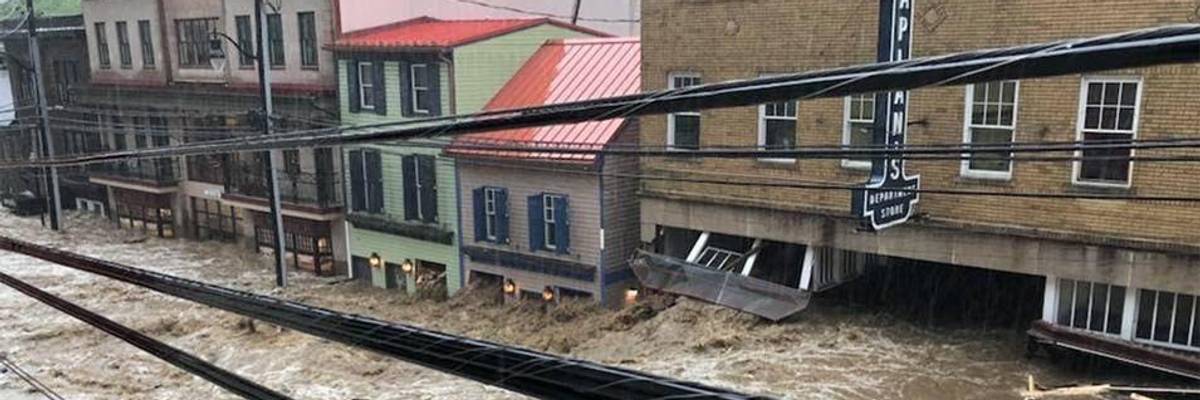
Ellicott City, Maryland--located less than 15 miles west of Baltimore--was devastating in late May when the second "1,000 year flood" in two years caused dangerous flash flooding throughout the city. (Photo: @BKMovie2018/Twitter)
Baltimore, Maryland on Friday became the latest city to file suit against major oil and gas companies, aiming to hold them accountable for the "potentially catastrophic" damage that the global climate crisis--which is largely the result of burning fossil fuels--is increasingly inflicting on coastal communities the world over.
"We're now on the front lines of climate change because melting ice caps, more frequent heat waves, extreme storms, and other climate consequences caused by fossil fuel companies are threatening our city and imposing real costs on our taxpayers."
--Baltimore Mayor Catherine Pugh
"These oil and gas companies knew for decades that their products would harm communities like ours," declared Baltimore City Solicitor Andre Davis. "They could have warned us. They could have taken steps to minimize or avoid the damage."
"In fact, they had a responsibility to do both, but they didn't, and that's why we are taking them to court," Davis added. "Baltimore's residents, workers, and businesses shouldn't have to pay for the damage knowingly caused by these companies."
Filed on Friday in the state's Circuit Court for Baltimore City, the lawsuit (pdf) names 26 companies--including BP, Chevron, ConocoPhillips, and ExxonMobil, and Royal Dutch Shell--some of which have been common targets in other climate liability suits filed across the country.
The city's suit outlines how these companies have misled the public about the risks of their products and reaped enormous profits, all while pouring greenhouse gases into the Earth's atmosphere that have resulted in "global warming, rising atmospheric and ocean temperatures, ocean acidification, melting polar ice caps and glaciers, more extreme and volatile weather, and sea level rise."
Baltimore is the East Coast's fifth-largest city, and features some 60 miles of waterfront. Lisa Anne Hamilton of the Center for International Environmental Law (CIEL) warned that the climate crisis "poses increasingly urgent and calamitous risks to Baltimore residents," noting that "in just the past two years, the Baltimore area was hit by two catastrophic 'once in a 1,000 year' storms."
"We're now on the front lines of climate change because melting ice caps, more frequent heat waves, extreme storms, and other climate consequences caused by fossil fuel companies are threatening our city and imposing real costs on our taxpayers," asserted Baltimore Mayor Catherine Pugh, who announced the lawsuit on Friday morning.
"Taxpayers in Baltimore can no longer afford to foot the bill for damages knowingly caused by climate polluters, nor should they have to," responded Richard Wiles, executive director of the Center for Climate Integrity. "The people of Baltimore deserve their day in court."
Baltimore's filing comes just a day after a federal judge dismissed New York City's suit against five top fossil fuels firms, and about a month after another federal judge tossed out a pair of suits brought by two cities in California. Despite those setbacks, several other cases are working their way through the courts, including a suit filed by Rhode Island, the first state to pursue this type of legal action against major oil and gas companies.
"The catastrophic impacts of climate change predicted by companies like Exxon decades ago have arrived," concluded Wiles. "It's only fitting then that the wave of lawsuits the industry have long feared and planned for have as well."
Dear Common Dreams reader, It’s been nearly 30 years since I co-founded Common Dreams with my late wife, Lina Newhouser. We had the radical notion that journalism should serve the public good, not corporate profits. It was clear to us from the outset what it would take to build such a project. No paid advertisements. No corporate sponsors. No millionaire publisher telling us what to think or do. Many people said we wouldn't last a year, but we proved those doubters wrong. Together with a tremendous team of journalists and dedicated staff, we built an independent media outlet free from the constraints of profits and corporate control. Our mission has always been simple: To inform. To inspire. To ignite change for the common good. Building Common Dreams was not easy. Our survival was never guaranteed. When you take on the most powerful forces—Wall Street greed, fossil fuel industry destruction, Big Tech lobbyists, and uber-rich oligarchs who have spent billions upon billions rigging the economy and democracy in their favor—the only bulwark you have is supporters who believe in your work. But here’s the urgent message from me today. It's never been this bad out there. And it's never been this hard to keep us going. At the very moment Common Dreams is most needed, the threats we face are intensifying. We need your support now more than ever. We don't accept corporate advertising and never will. We don't have a paywall because we don't think people should be blocked from critical news based on their ability to pay. Everything we do is funded by the donations of readers like you. When everyone does the little they can afford, we are strong. But if that support retreats or dries up, so do we. Will you donate now to make sure Common Dreams not only survives but thrives? —Craig Brown, Co-founder |
Baltimore, Maryland on Friday became the latest city to file suit against major oil and gas companies, aiming to hold them accountable for the "potentially catastrophic" damage that the global climate crisis--which is largely the result of burning fossil fuels--is increasingly inflicting on coastal communities the world over.
"We're now on the front lines of climate change because melting ice caps, more frequent heat waves, extreme storms, and other climate consequences caused by fossil fuel companies are threatening our city and imposing real costs on our taxpayers."
--Baltimore Mayor Catherine Pugh
"These oil and gas companies knew for decades that their products would harm communities like ours," declared Baltimore City Solicitor Andre Davis. "They could have warned us. They could have taken steps to minimize or avoid the damage."
"In fact, they had a responsibility to do both, but they didn't, and that's why we are taking them to court," Davis added. "Baltimore's residents, workers, and businesses shouldn't have to pay for the damage knowingly caused by these companies."
Filed on Friday in the state's Circuit Court for Baltimore City, the lawsuit (pdf) names 26 companies--including BP, Chevron, ConocoPhillips, and ExxonMobil, and Royal Dutch Shell--some of which have been common targets in other climate liability suits filed across the country.
The city's suit outlines how these companies have misled the public about the risks of their products and reaped enormous profits, all while pouring greenhouse gases into the Earth's atmosphere that have resulted in "global warming, rising atmospheric and ocean temperatures, ocean acidification, melting polar ice caps and glaciers, more extreme and volatile weather, and sea level rise."
Baltimore is the East Coast's fifth-largest city, and features some 60 miles of waterfront. Lisa Anne Hamilton of the Center for International Environmental Law (CIEL) warned that the climate crisis "poses increasingly urgent and calamitous risks to Baltimore residents," noting that "in just the past two years, the Baltimore area was hit by two catastrophic 'once in a 1,000 year' storms."
"We're now on the front lines of climate change because melting ice caps, more frequent heat waves, extreme storms, and other climate consequences caused by fossil fuel companies are threatening our city and imposing real costs on our taxpayers," asserted Baltimore Mayor Catherine Pugh, who announced the lawsuit on Friday morning.
"Taxpayers in Baltimore can no longer afford to foot the bill for damages knowingly caused by climate polluters, nor should they have to," responded Richard Wiles, executive director of the Center for Climate Integrity. "The people of Baltimore deserve their day in court."
Baltimore's filing comes just a day after a federal judge dismissed New York City's suit against five top fossil fuels firms, and about a month after another federal judge tossed out a pair of suits brought by two cities in California. Despite those setbacks, several other cases are working their way through the courts, including a suit filed by Rhode Island, the first state to pursue this type of legal action against major oil and gas companies.
"The catastrophic impacts of climate change predicted by companies like Exxon decades ago have arrived," concluded Wiles. "It's only fitting then that the wave of lawsuits the industry have long feared and planned for have as well."
Baltimore, Maryland on Friday became the latest city to file suit against major oil and gas companies, aiming to hold them accountable for the "potentially catastrophic" damage that the global climate crisis--which is largely the result of burning fossil fuels--is increasingly inflicting on coastal communities the world over.
"We're now on the front lines of climate change because melting ice caps, more frequent heat waves, extreme storms, and other climate consequences caused by fossil fuel companies are threatening our city and imposing real costs on our taxpayers."
--Baltimore Mayor Catherine Pugh
"These oil and gas companies knew for decades that their products would harm communities like ours," declared Baltimore City Solicitor Andre Davis. "They could have warned us. They could have taken steps to minimize or avoid the damage."
"In fact, they had a responsibility to do both, but they didn't, and that's why we are taking them to court," Davis added. "Baltimore's residents, workers, and businesses shouldn't have to pay for the damage knowingly caused by these companies."
Filed on Friday in the state's Circuit Court for Baltimore City, the lawsuit (pdf) names 26 companies--including BP, Chevron, ConocoPhillips, and ExxonMobil, and Royal Dutch Shell--some of which have been common targets in other climate liability suits filed across the country.
The city's suit outlines how these companies have misled the public about the risks of their products and reaped enormous profits, all while pouring greenhouse gases into the Earth's atmosphere that have resulted in "global warming, rising atmospheric and ocean temperatures, ocean acidification, melting polar ice caps and glaciers, more extreme and volatile weather, and sea level rise."
Baltimore is the East Coast's fifth-largest city, and features some 60 miles of waterfront. Lisa Anne Hamilton of the Center for International Environmental Law (CIEL) warned that the climate crisis "poses increasingly urgent and calamitous risks to Baltimore residents," noting that "in just the past two years, the Baltimore area was hit by two catastrophic 'once in a 1,000 year' storms."
"We're now on the front lines of climate change because melting ice caps, more frequent heat waves, extreme storms, and other climate consequences caused by fossil fuel companies are threatening our city and imposing real costs on our taxpayers," asserted Baltimore Mayor Catherine Pugh, who announced the lawsuit on Friday morning.
"Taxpayers in Baltimore can no longer afford to foot the bill for damages knowingly caused by climate polluters, nor should they have to," responded Richard Wiles, executive director of the Center for Climate Integrity. "The people of Baltimore deserve their day in court."
Baltimore's filing comes just a day after a federal judge dismissed New York City's suit against five top fossil fuels firms, and about a month after another federal judge tossed out a pair of suits brought by two cities in California. Despite those setbacks, several other cases are working their way through the courts, including a suit filed by Rhode Island, the first state to pursue this type of legal action against major oil and gas companies.
"The catastrophic impacts of climate change predicted by companies like Exxon decades ago have arrived," concluded Wiles. "It's only fitting then that the wave of lawsuits the industry have long feared and planned for have as well."

